

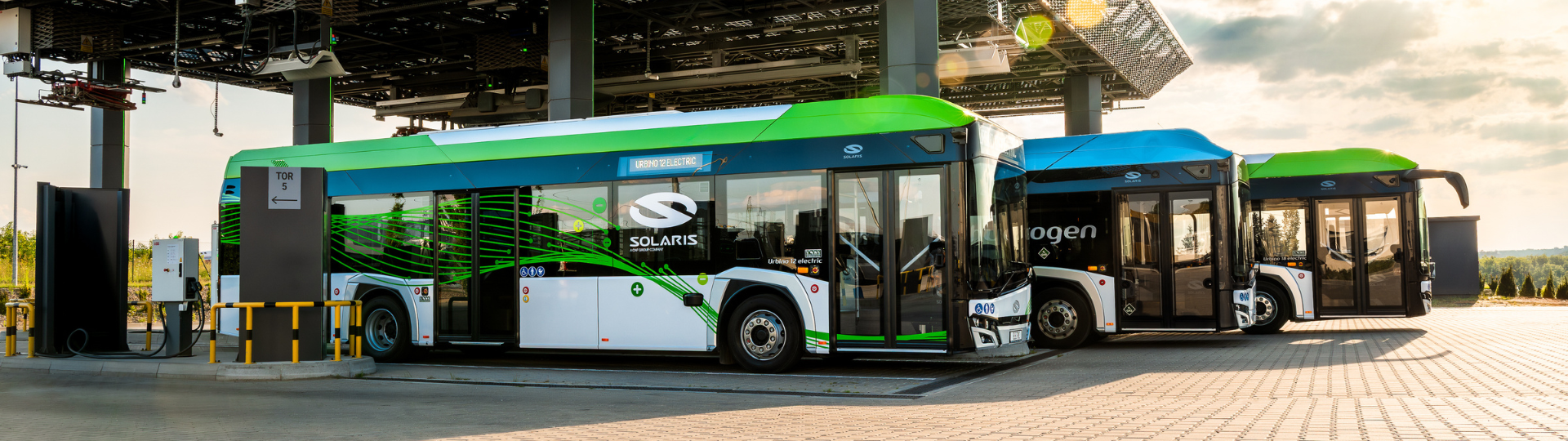
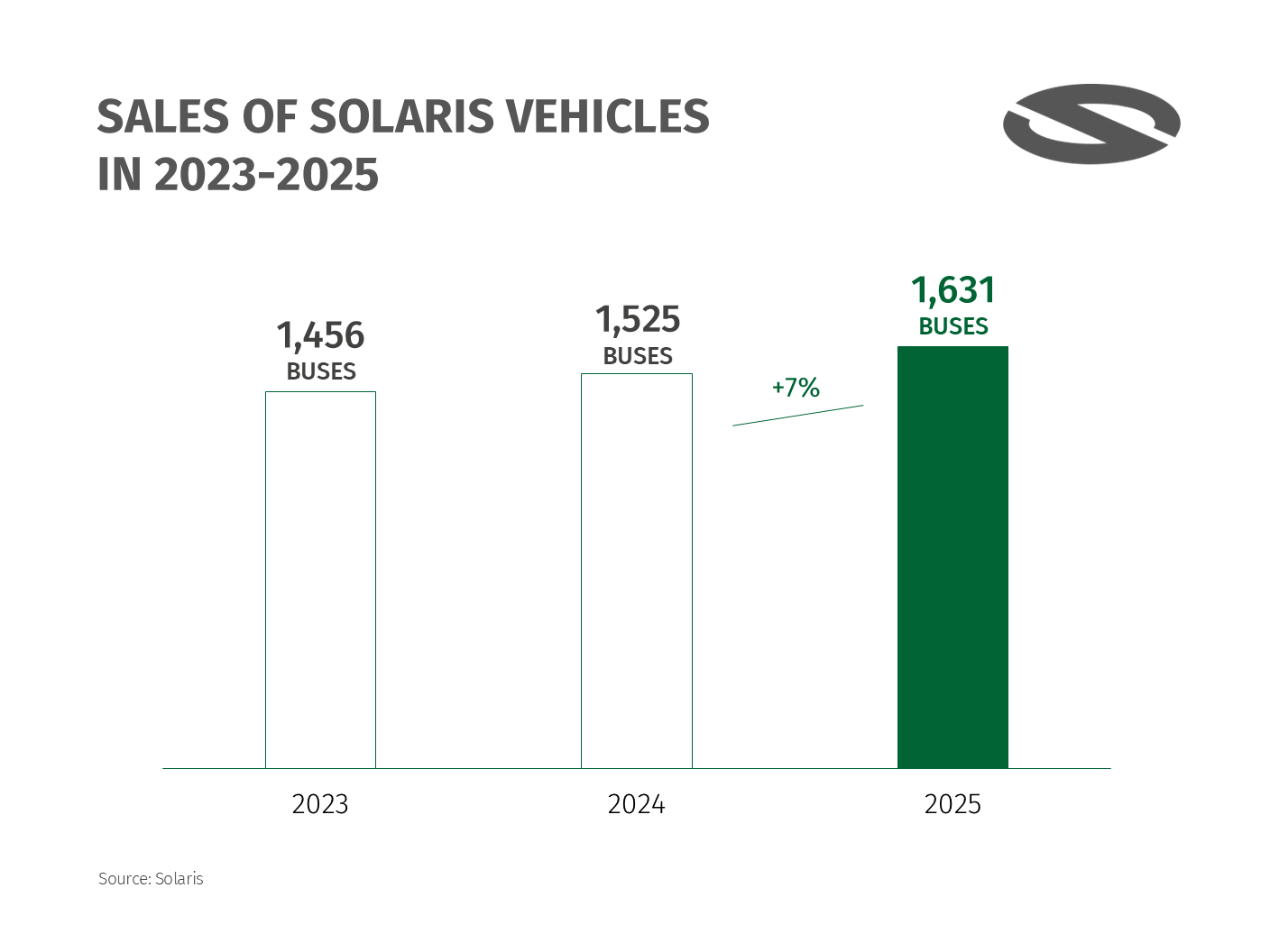
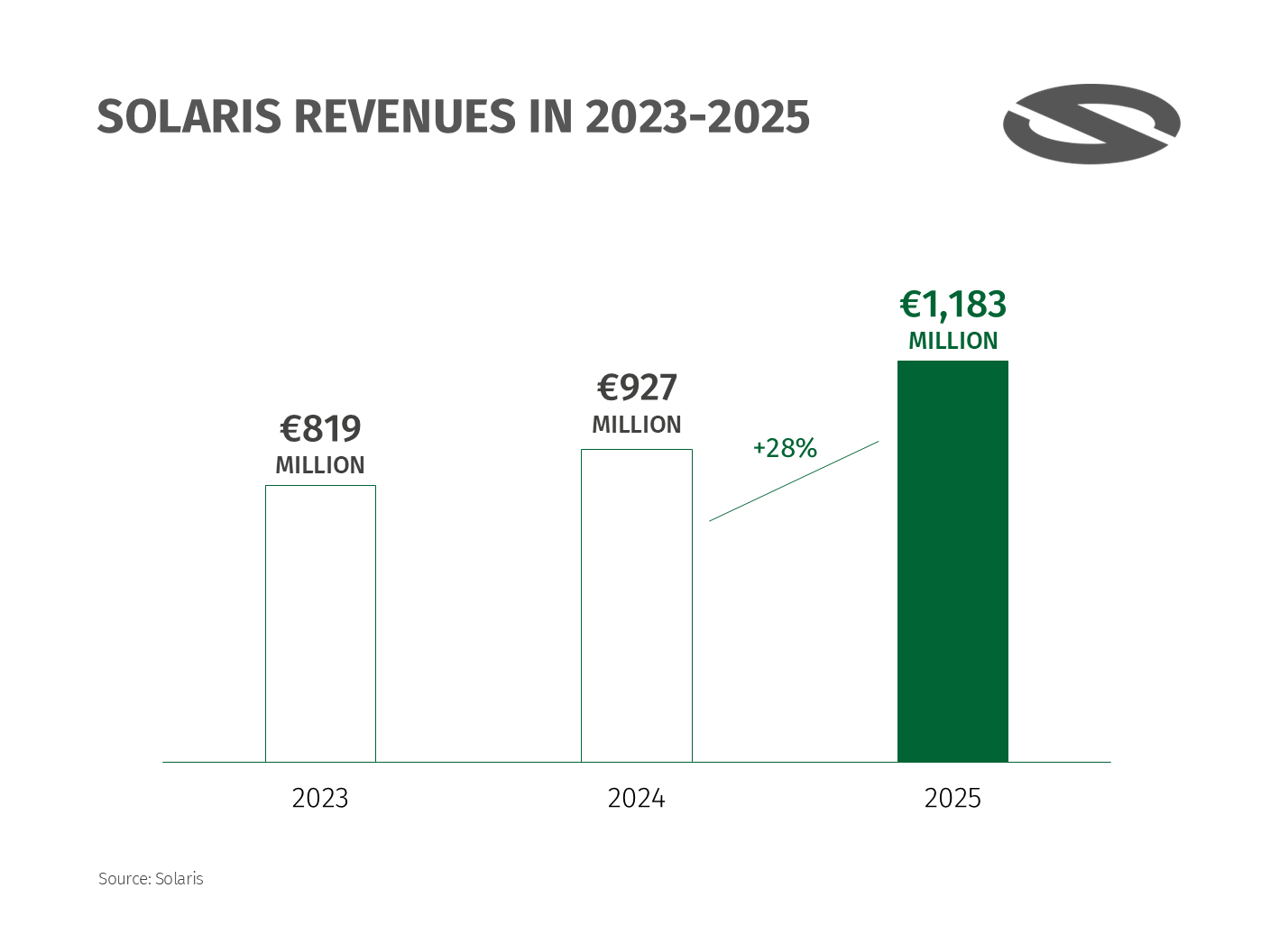
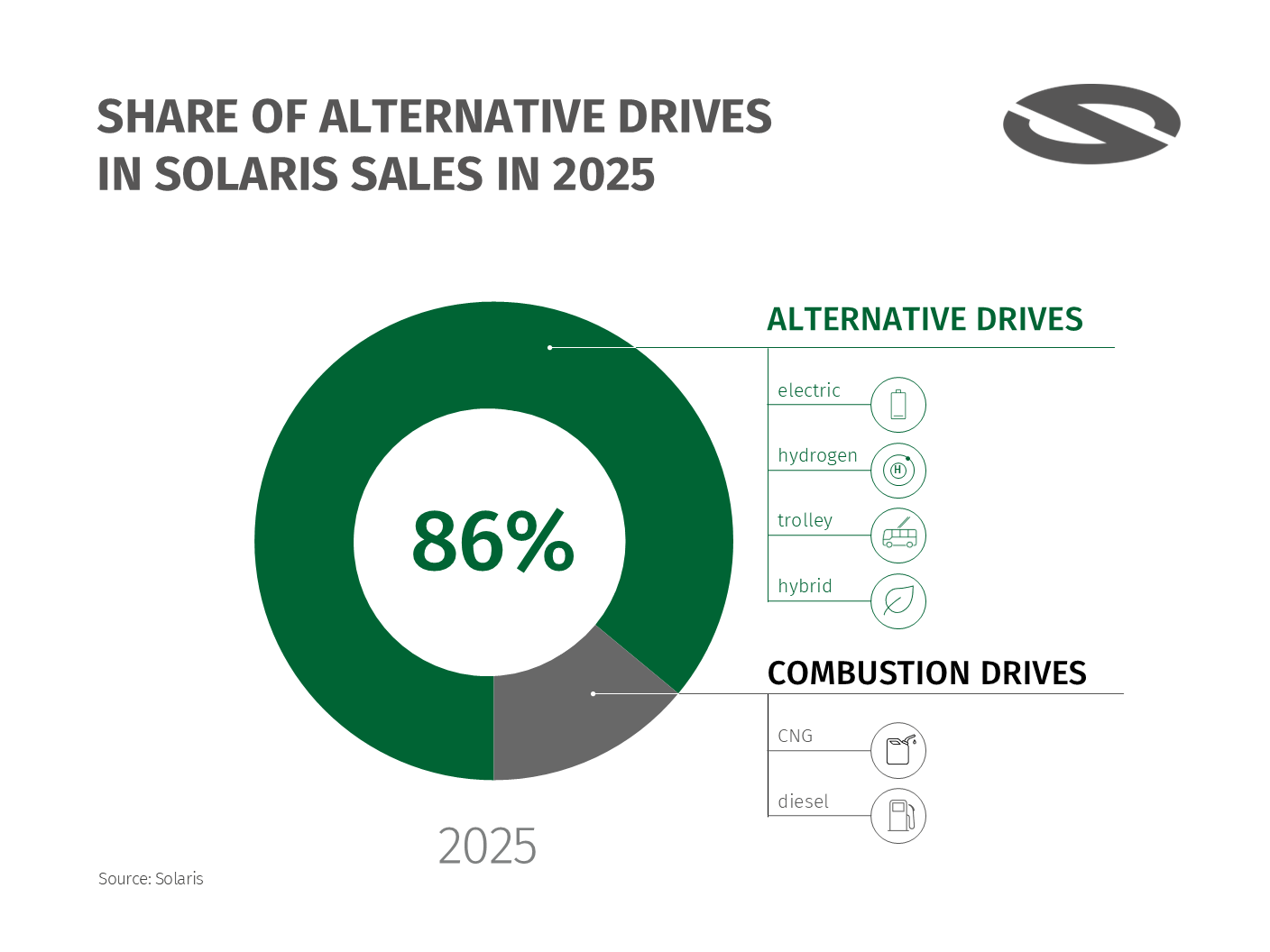
2025 was a year of significant growth and consolidation for Solaris Bus & Coach sp. z o.o. on the European e-mobility market. The company delivered 1,631 vehicles (+7% year-on-year), and revenues reached €1.183 billion (+28% year-on-year). Low- and zero-emission vehicles accounted for 86% of deliveries and more than 93% of sales value. In 2025, Solaris secured orders for 2,780 vehicles – the highest figure in the company’s history. These results confirm the sustained demand for Solaris vehicles and solutions, while the scale of the order book ensures predictable revenues and a foundation for further growth in the coming years.
Sales growth in 2025
In 2025, Solaris delivered 1,631 vehicles to customers across 15 countries, representing a 7% increase compared to 2024. In line with its strategy, the company focused its sales activities on the premium segment of low- and zero-emission vehicles, which contributed to revenue growth and improved contract profitability.
The total revenue amounted to €1.183 billion, 28% higher than in 2024.
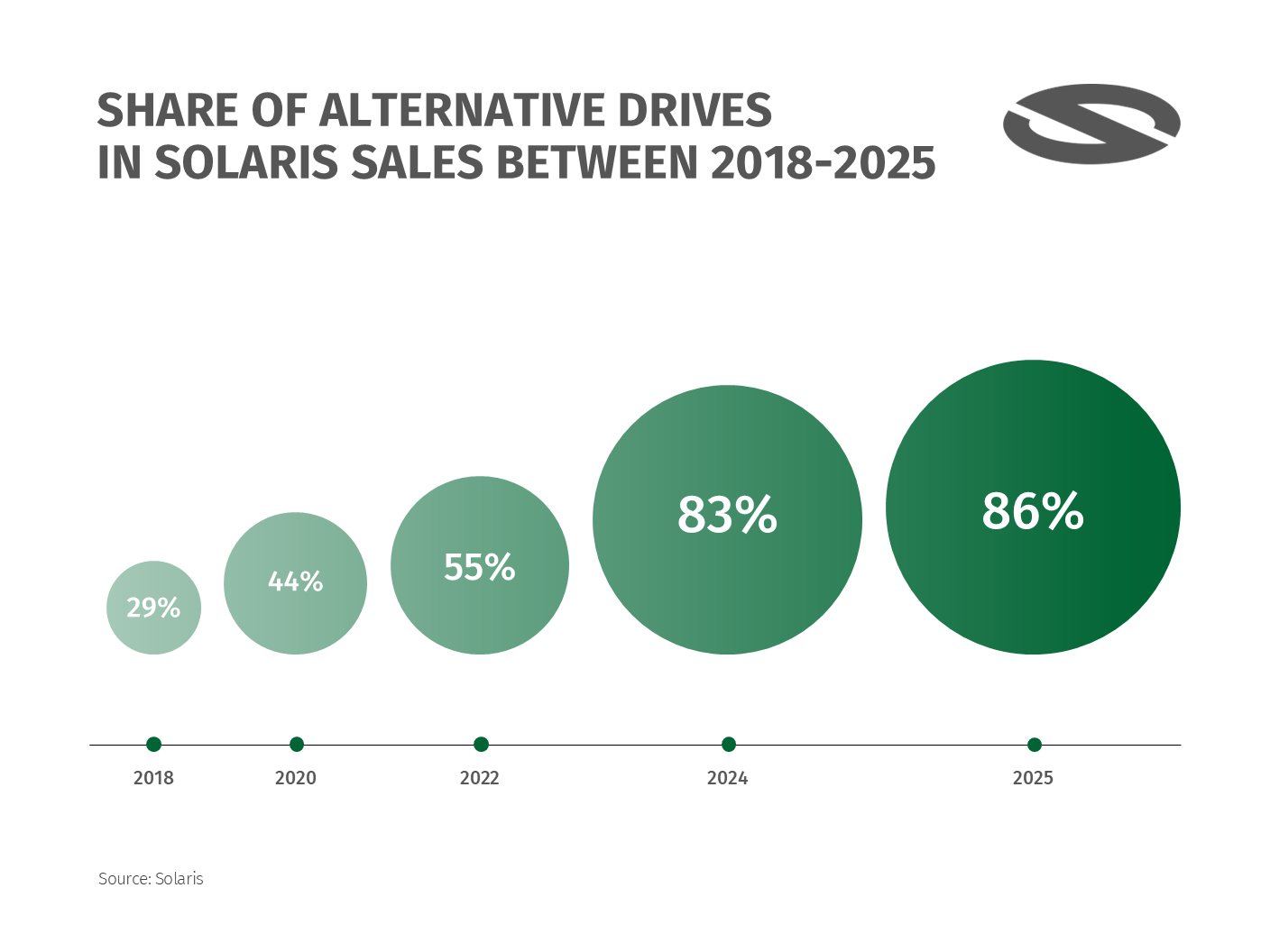
The vast majority of contracts executed in 2025 – 86% – involved fully zero-emission or low-emission vehicles. Notably, low- and zero-emission vehicles also accounted for more than 93% of the total sales value.
Deliveries in 2025
The largest recipients of Solaris vehicles in 2025 were customers from Poland, Italy, Germany, Sweden, the Netherlands, and Switzerland. Sales were primarily driven by high volumes of electric buses, hydrogen buses, and trolleybuses. Deliveries included 916 electric buses and 306 hydrogen buses – the highest annual delivery volumes of electric and hydrogen vehicles in the company’s history.
Among the major electric bus customers were the Swedish operator Nobina, which introduced 118 Solaris buses into service, and Milan’s ATM, which expanded its fleet with 97 Urbino 18 electric articulated buses. Significant deliveries of e-buses were also made to Transdev in Utrecht, CTM in Cagliari (Sicily), BVG in Berlin, PostAuto in Switzerland, and operators in Romania.
In the hydrogen bus segment, the largest batch was deployed in Bologna, where TPER received 88 Urbino hydrogen buses. Subsequent series were delivered to German operators in Kerpen, Wuppertal, Cologne, Gummersbach, and Duisburg, as well as to Czech operator Martin Uher.
Strong order book and production outlook
In 2025, Solaris secured orders for 2,780 vehicles, setting a company record. The largest order volumes came from Poland (1,196 vehicles). A significant share of new contracts also concerned deliveries to operators in Sweden, Germany, Switzerland, Italy and Canada.
Key contracts in 2025 included an order for up to 270 electric articulated buses for BVG in Berlin, the company’s first order in Canada – 184 trolleybuses for TransLink in Vancouver – as well as contracts with VR Sverige and Nobina in Sweden, totaling 378 electric buses of various lengths.
The order portfolio in 2025 was dominated by electric buses, trolleybuses, hybrids, and hydrogen buses, representing nearly 90% of all contracted vehicles. At year-end, the order book, including service contracts, was valued at €2.4 billion, providing stable production prospects for the coming years.
Market shares and position in the zero-emission segment
High delivery volumes strengthened Solaris’s market position. In 2025, Solaris ranked third among all city bus manufacturers in Europe, regardless of drivetrain type.
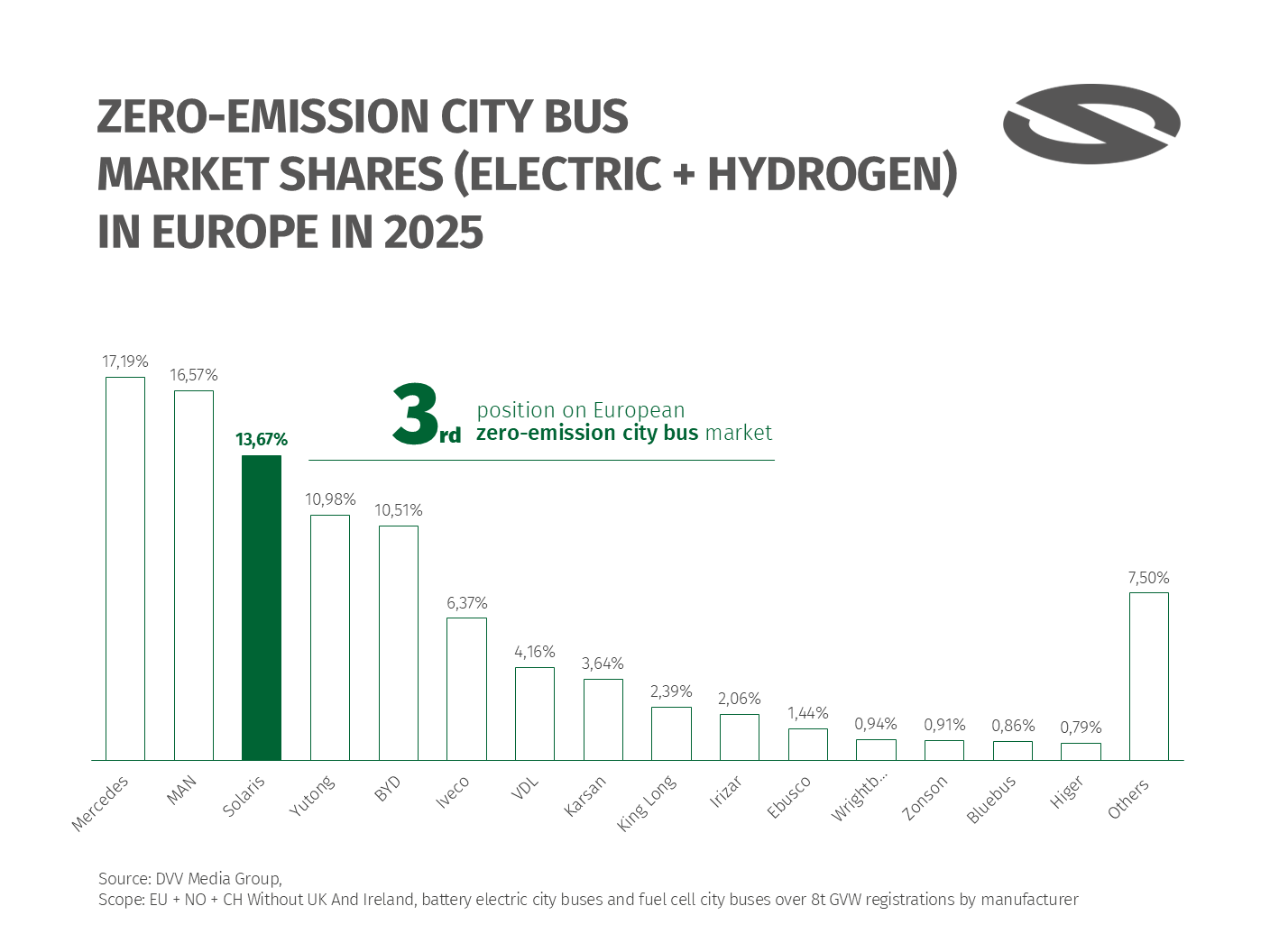
In the zero-emission segment, the company achieved an 11% share of the battery bus market and a 58% share in the hydrogen bus segment. Taken together, including both battery and hydrogen buses, the company ranked third in Europe in the zero-emission city bus segment in 2025, with a nearly 14% market share.
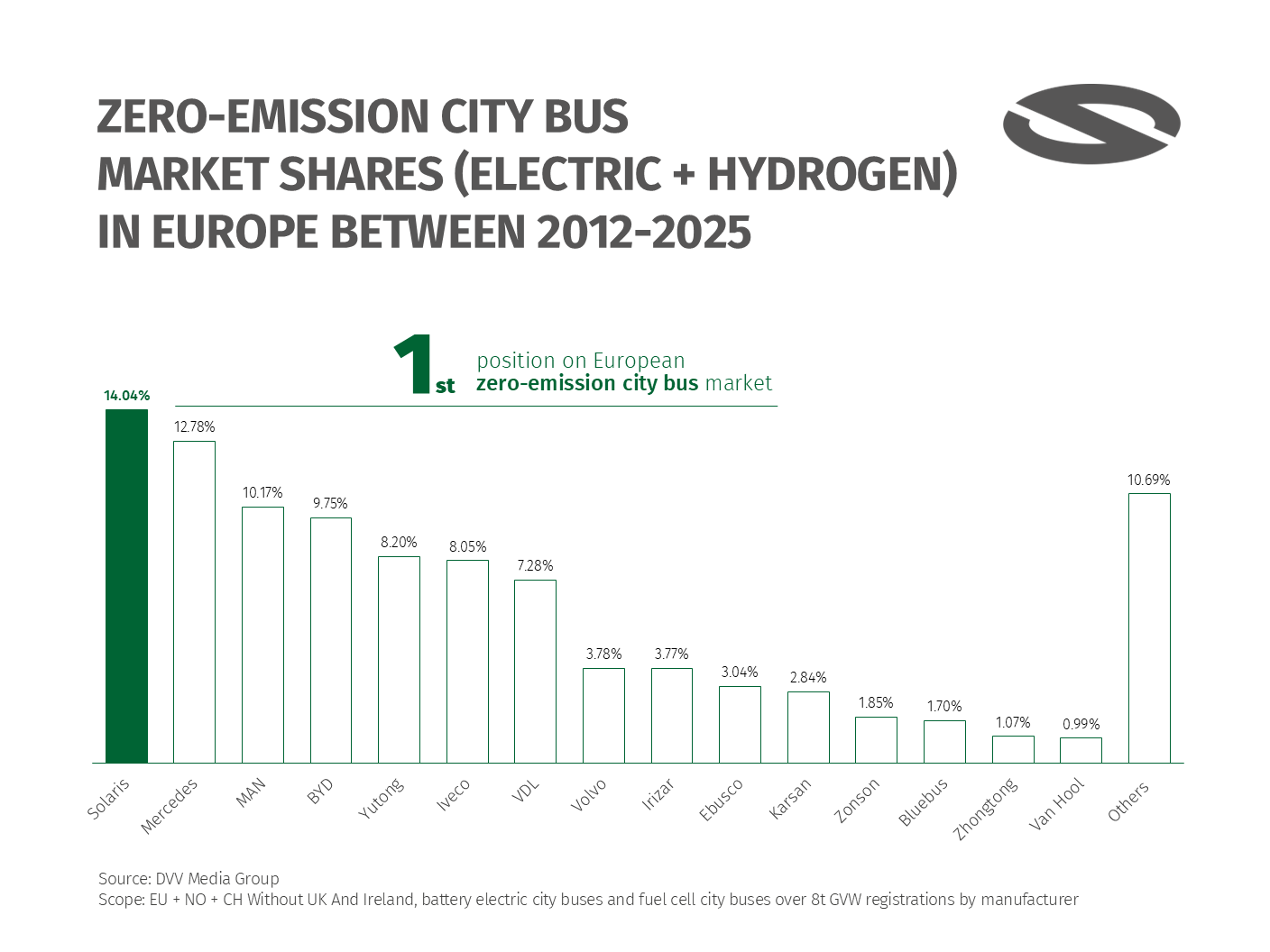
In the long-term perspective, covering the total number of zero-emission buses delivered in Europe from 2012 through the end of 2025, Solaris maintained its position as the market leader, as in the previous year.
European cities choose transport solutions adapted to local conditions – such as required range, route characteristics, or existing infrastructure – rather than relying on a single drivetrain technology. For this reason, Solaris has been developing three key branches of zero-emission transport in parallel: battery, hydrogen, and trolleybus technologies, addressing the diverse needs of operators pursuing transport transformation.
Innovation and product development
In 2025, Solaris introduced the series production of vehicles with modular drive (MD) technology in 10.5-, 12-, and 18-meter configurations. This solution enhances driver and passenger comfort, simplifies maintenance, and improves energy efficiency.
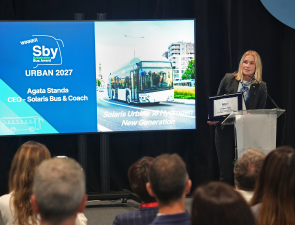
At Busworld 2025, the latest model in this series – the Solaris Urbino 10.5 electric – had its world premiere and received a Sustainable Bus Award 2026 in the Urban category.
It is also worth noting that the articulated hydrogen bus Solaris Urbino 18 hydrogen was named “Bus of the Year 2025”.
The company also worked on a new family of zero-emission intercity buses (10.8 m, 12 m, 13 m), in low-floor and low-entry versions, available both as battery and hydrogen vehicles. Parallel development focused on vehicles specifically designed for the North American market.
Extension of the service offering: retrofit of zero-emission vehicles
In 2025, Solaris extended its after-sales services portfolio to include the retrofit of zero-emission vehicles. This solution enables the modernisation of earlier-generation electric buses through the replacement of selected components, primarily batteries and drivetrain elements. As a result, it significantly extends the operational lifespan of electric buses and improves their performance parameters.
The scope of the service includes technical analysis, preparation of engineering documentation, replacement of energy storage systems, integration with existing charging infrastructure, and updates to energy and thermal management systems (BMS and BTMS).
The first vehicles after modernisation have already been deployed in Kraków, where Solaris is carrying out the retrofit of electric buses for the Cracow public transport operator MPK. Further projects are currently underway for operators in Berlin, Hamburg, Paris and Warsaw.
The offering currently covers battery buses and trolleybuses, and may also include hydrogen vehicles in the future.
Expansion into the North American market
A key milestone in 2025 was the signing of Solaris’s first contract in Canada. TransLink Vancouver ordered 107 12-meter trolleybuses, followed by an option to extend the order by 77 articulated trolleybuses.
This contract represents a significant step in establishing Solaris’s presence outside Europe. First trolleybus deliveries are scheduled for 2026.
Outlook for 2026
2025 confirmed Solaris’s stable position as one of Europe’s leading suppliers of low- and zero-emission buses. The company enters 2026 with a strong order book and a clear development direction, focused on zero-emission technologies, increased production capacity, enhanced service support, and continued expansion into new markets.








Informationen über Solaris
Solaris Bus & Coach sp. z o.o. ist einer der führenden europäischen Hersteller von Stadt- und Überlandbussen mit Schwerpunkt auf die Entwicklung von emissionsfreien Fahrzeugen, d. h. Elektro-, Wasserstoff- und Oberleitungsbussen. Dies bedeutet zugleich das breiteste Angebot an emissionsfreien Fahrzeugen auf dem europäischen Markt und die Position des Marktführers in diesem Marktsegment mit einem Anteil von 15,2%. Knapp 25.000 bisher gelieferte Solaris-Fahrzeuge sind bereits in 33 Ländern und 850 Städten in ganz Europa und außerhalb im Einsatz. Solaris ist Teil der spanischen Gruppe CAF (Construcciones y Auxiliar de Ferrocarriles) S.A. Vom Konzept über die Entwicklung bis hin zur Fertigung entstehen Solaris-Busse in Polen. Alle Aktivitäten des Herstellers stehen im Einklang mit seiner Markenbotschaft: „Wir ändern das Gesicht des ÖPNV“. Solaris ist auch ein aktiver Partner für städtische Verkehrsbetriebe und bietet ihnen umfassende Unterstützung bei der Umstellung auf emissionsfreie Mobilität.
Sonstige Informationen
Mateusz Figaszewski
Institutional Partnerships and External Relations Director
mateusz.figaszewski@solarisbus.com